
Kiern Vale Handbook
Chapter 3: Life in Kiern Vale
Prologue | Climate and Calander
| Population | Languages | Food and Nutrition
| Attire | Trade and Money
Law and Order | Education | Travels
|
Trade and subsistence
in Kiern Vale Two generations of life after that
shattering of the imperial rule (at least, since the assassination of the
last En’mirian prefect and his family, 45 years ago), and the partial decline
of trade, have significantly changed the way of life in the vale. The collapse of the subterranean
roads leading to Til’maris in the west (replaced by
winding and slow mountain paths), effected the once flowing trade with the
port city of Til’mirlen, and the transformation of
the Urgaka plains into endless swamps, eradicated
the trade which via the northern roads. In contrast, the vale still maintains
ongoing trade with the various settlements in the Vartharon
Forest (The source of most wood for construction), and with the castles and
temples of the Blue Reflection's followers on the eastern Karansil
ridge (the source of most metal ores). There is also some trade with the
kingdom of Orm’theril on the far north-east of the Karansil mountains. However, the intensifying monster
attacks on some of the major Karansil mines, and
the growing tension in Orm’theril have affected
those trade routes as well, at least to some extent. Trade and
politics Kiern Vale is currently at a
crossroads: the outer world becomes more dangerous; strange and shadow forces
and creatures are seen at the borders of the vale, threatening the
remaining trade routes, and internal tensions are coming to a boil, threatening
the fragile equilibrium. As a result, many of the traders and some of the
local dignitaries are inclined to heed the offers of the Regent lady Los’erlin A-Rylarion who
seized control over the Tilmaris region to the
west: they are willing to accept her rule or at least her patronage. In
return, they hope for the opening of new trade routes, and most importantly –
defense against monsters and other rising dangers. In contrast, other nobles and local factions, on the other
hand, vehemently oppose those proposals – both for religious and political
reasons – as the Regent Lady rules in the name of the hated great rebel “Grey
Rose” and her offspring. Other, more practical reasons, is due to reluctance
to give up independence and bow before a new supreme ruler, who may demand
high taxes – even though, for now, the Regent Lady has not – yet – made such
demands. Peasants, craftsmen and Artisans Most of the inhabitants of Kiern Vale are peasants. Some of
them are subject to noble landowners, either fully or partially (though
actual serfdom does not exist in the vale), while others till their own
fields and farms. The farther they are from the great estates, the more
independence most of the peasants enjoy, at the cost of reduced protection
and contact with the trade routes – which forces them to invest more labor in
being self-sufficient. In the larger settlements, greater labor specialization
exists. Some townsfolk are exclusively craftsmen and traders, while others
maintain small scale truck gardens and livestock near their homes. The city of En’mirlor, which is
the most populated and crowded settlement in the Vale, is the home of a
significant numbers of specialist master craftsmen, service providers and
artisans. Various guilds dominate most of the crafts – from the metalworkers’
guild, to the weavers’ guild and the builders’ guild. Those guilds not only
serve as economic centers, but also control the production and trade of finely
crafted goods which are the mainstay of the old provincial capital. These
goods range from magical weapons to exquisite furniture, which are
challenging to find elsewhere. In the poorer quarters, especially those on the murky soil
outside the city walls, many live “hand to mouth”, combining small-scale
gathering (mostly mushrooms, and edible moss and herbs) with small-scale
farming, and livestock rearing. This subsistence farming is supplemented by
small scale trade, manual labor – and crime. A few other artisans and master craftsmen can also be found
in some smaller towns around the major noble estates, or in and around the
military fortress of Gren-A-Drum, where weapon
smiths and crafters of other battle worthy equipment reside, supplying the
legion soldiers which guard to passage to the Ogre infested swamps of Urgaka. Other artisans, especially master metalworkers and stone crafters,
live in the Garnet Yards beneath the walls of Lord Kor-Om’thel
castle in the east of the vale. Its position near the main road ascending to
the Karansil ridge, dominates passage to the
mountain zone and its mines, which are controlled by lords, orders or
mountain clans loyal to the Celestial Blue Reflection. Money in Kiern Vale During the imperial era, only a small handful of chosen
coin mints were authorized to produce gold coins. Local mints, like the one
in Kiern Vale, were permitted to produce cheaper, local coins based on
predetermined quantities. The closest gold coin mint near the Vale was
located on a well-fortified island near Til’mirlen
port city – now deeply submerged beneath the ocean. The vale local coin mint,
located in En’mirlor, is still operating today, and
producing two types of local coins, though in smaller quantities. On the
other hand, many locals in remote parts of the vale have been forced to reliance
on barter. Local coins Ban: the most common currency in the vale, made of copper with
a small amount of iron. It serves as the standard unit for calculating the
value of most goods. Most Ban coins currently in use were minted in En’mirlor before the Great Shattering. Their obverse side
features the helmeted head of an En’mirian legionnaire, with the En’mirian
prefect who reigned when the coin was minted, along with the minting year,
inscribed beneath. On the reverse side a bull or rooster signifying prosperity
is featured. Coins minted after the murder of Prefect Los’tirn do not include any inscription on that side,
except for the minting year. Similar foreign coins: Lin and Var are copper coins minted on Karansil ridge or in one of the mints of the Vartharon forest, and some of them found their way to
Kiern Vale through trade. Those coins carry the image of a mining pick (Lin)
or a thorny tree (Var), however they are entirely equivalent in value to the
local Ban. Tilyn: A local currency valued at 5 Ban for each Tilyn. Made of an alloy with a sliver base, it appears in
various forms depending on the region where it was minted. The local version
features a water pool with a blured gem figure
above it. The version minted in Til’mirlen depicts
a sailing ship and two crossed swords with a background of the sea. Other
versions include a mountain peak (Karansil ridge),
a horse (Orm’theril) and a dragon (Vartharon). In all the Tylin coins, the other side
displays the name of the prefect or ruler during whose reign the coin was
minted. En’mirian Gold Coins The Enorn is the official gold
currency of the En’mirian empire, minted during the imperial era in four
different (though equal in value) shapes. Each shape bears the image of one
of the four Celestial Reflections: Linorn (Blue), Darnorn (Golen), Omnorn (Grey)
and Relnorn (Red). The common Anorn was made of an alloy of gold and some silver,
featuring the image of one of Celestial Reflections on one side, and the seal
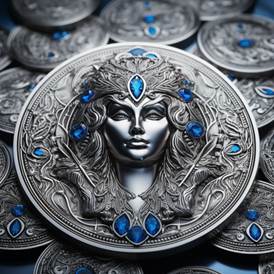
of the imperial mint that coined it on its other side. Celestial Enorn: The most precious and magnificent currency,
minted from a platinum and gold alloy, with embedded gemstone particles of a
matching color. It required a complex work to mint, aided by magical means. Very
few mints, mainly in the Imperial capital Selentir and other sacred places,
had the ability to produce such coins. It is rumored that one of them – located
high in the Karansil ridge, still exists, but no
celestial Enorns were minted there since the Great
Shattering.
Rare foreign coins Occasionally,
one might come across rarer foreign coins that somehow found their way to
Kiern Vale: such coins can be the disturbing Darum (“Sun Coin”), of the South
Seas slavers; The Winged Crown which was minted in the Mistweaver's fallen kingdom,
and even the strange Raamog mainly used by ogre
wizards, with its unique elongated shape, sometimes engraved with runes and
hints for the mark of one of the emperor-wizards of old. An
in-depth description of these coins, as well as additional types of currency,
can be found on the Melestra website, and will also be featured in the future
in the advanced player handbook.
A
more detailed list of goods and prices can be found in the beginner player
handbook or in Melestra’s website. |
|||||||||||||||||||||||||||||||||||||||||||||
Back to the index of the
English version | Back to the index of the
Kiern Vale guide
Created and edited by Gideon Orbach (2017) ©
All rights reserved. Commercial use and/or any profit-making purpose is
strictly prohibited without explicit permission from the creator, in writing
and in advance. Noncommercial/personal use with no profit aim is allowed (and
even recommended!)