
Kiern Vale Handbook
Chapter 2: The Races of Melestra
Prologue | Introduction | En'miri | Far'lil | Gurg | Mistweavers | Ogres | Ralg'kril
Mistweavers
Race type:
Demi-Humans Lifespan:
150-250 years Average height:
1.75m (both males and females)
The
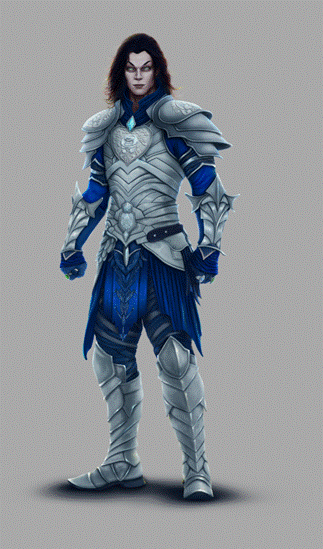
Mistweavers are a demi-human race of refined appearance. They are
pale-skinned like the En’miri; their eyes glimmer more than human eyes, and
the eye pupils appear blurred. Their eye color ranges from intense green to
light grey or blue-grey. Their eyebrows are delicate, thin and long, slanting
upwards; their hair color ranges from shiny black to a bright golden hue. Mistweavers
have a distinctive body odor, reminiscent of the sharp, cool air after a
storm, and they frequently complain about “the terrible stench emanating from
the bodies of humans and other races”. They favor elegant and sophisticated
attire, in typical colors of white, azure or light silver supplemented with
jewelry, mainly engraved with complex (some say too complex) shapes of
flowers, and also bright embroideries that gleam from within their clothing –
a sight that is considered by many as an overly adorned and heavily detailed
style.
Origin and history Mistweavers
originate from Narlirdrea, the Western Continent of the known world. They
consider themselves the “sole true descendants” of an ancient and extremely
powerful race named Khar’ril, whose empire ruled
over the entire continent over 10,000 years ago. The Mistweavers established
their own kingdom, in honor of their deity Kaharleiry,
the queen of light. This kingdom, often known as “The Kingdom of Radiant
Light” or “The kingdom of blessed light”, was known as a living wonder, with
its divine beauty, its magical gardens, grand palaces, and intricate arts and
ceremonies. On
the other hand, many have disdained the Mistweaver culture as nearly
grotesque in its devotion to extravagant apperances,
overly long ceremonies and songs, and chivalric orders far more adept in
complex council protocols and heraldry then in actual fighting. When the
En’mirian legions invaded Narlirdrea, the Mistweavers army was quick to
surrender, a capitulation which the Celestial Reflections repaid by
maintaining the Mistweaver kingdom as a “favored vassals” who remained
relatively independent; though it seemed that over the years, the Mistweavers
relayed too much on the protection of the En’mirian legion, letting their
armies to degrade even further behind their white-clad armors and extravagant
war customs. The
Great Shattering did not devastate the Western Continent of Narlirdrea as
badly as it the Central Continent of Melestra, but the Mistweavers suddenly
found themselves berfit of the imperial protection
on which they had grown dependent. The hammer fell few decades later, when
seven human and demi-human nations from the southern parts of Narlirdrea
formed an alliance, sworn to wipe out the “Kingdom of Blessed light”, which
had outraged them with its arrogant, patronizing attitude, and whose wealth
and magic they coveted. In
this war, the sorcerers of the Gar-Engul tribe, one
of the ancient enemies of the Mistweavers, utilized a new and lethal weapon:
The newly bred Engurg: hordes of mutated,
grey-skinned and sadistic humanoids only superficially resembling their Gurg
progenitors. After around 12 years of war, the Mistweaver kingdom was
annihilated. Its armies and knight orders crumbled; its wonderous cities,
temples and palaces sacked and ruined; and its magical gardens burnt. Most of
the Mistweavers were either slaughters or sold into slavery. Only in few
regions within the mountains of northern Narlirdrea did the Mistweavers still
hold their ground, mostly because the enemy alliance broke up shortly after
the fall of the Mistweavers capital. The
Mistweavers residing in the Kiern Vale at the time of the default campaign
are mostly refugees who escaped the destruction, or who had later freed
themselves or been freed from slavery. The once proud and adorned people of
the radiant west, are now poor refugees forced to earn their bread as
craftsmen, soldiers and various other forms of labor which are considered
“bitter mockery of their skills and heritage”. Many find themselves exposed
to condensation, or exploitation by the local humans – even those lords who
offered them shelter and protection. In
the aftermath of the sacking of their light-blessed kingdom, and loss of
nearly everything that seemed eternal, many Mistweavers suffered a terrible
shock, not to mention doubts about any reason to keep their former faith
(“where was she, oh the blessed Queen of Light, when our children were burnt
alive?”) Surviving
Mistweavers traumatized by the destruction of their civilization may display
absolute numbness or terrible anger and vows to continue fighting for the
light until the last drop of blood, sometimes with self-blame for the
corruption and laziness which doomed their homeland. Others sink into cynical
mockery and denounce the worship of the light was never anything more than a
worthless fraud. Society, religion, and values Beyond
the façade of sweetened language and ostentatious displays of honor,
Mistweaver society, is a strict hierarchy fixing every individual in their
place, even more than their En’mirian counterparts. Although the Mistweavers
abhorred slavery in all of its forms, in the “Kingdom of blessed light” every
individual had a designated place and role, with a specific purpose and very
precise expectations of behavior and appearance (and often, even who to marry
and with whom to bear offsprings). The higher the rung in the hierarchy, the
more rigid the role. In
Mistweavers society, particularly in the upper courts of the radiant light,
there were dozens of different titles, describing various ranks, making it
very challenging for non-Mistweavers to distinguish between them. At times,
the whole place seemed like a “living fairytale”, where every detail was
pre-planned, in some kind of meticulously oiled mechanism. Some
claim that the complexity of this society, in which every decision was
entwined with ceremonies and intricacies, had doomed it to oblivion, and that
three centuries under En’mirian protection during which which
the Mistweavers “forgot how to fight their own wars" accelerated this
decline. Before
the burning of their kingdom, the Mistweavers viewed themselves as noble
protectors of light, exemplifying moral values and goodness; they admired
beauty, some say to an extreme extent, and seemed to be obsessed with
preserving and restoring the glory of the ancient Kahr’ril,
through gradual ascending of their own blood and powers. The Mistweavers
composed voluminous manuscripts of sophisticated myths, and their craftsmen
specialized in painstaking creation of minutely detailed patterns on
exquisite garments eagerly sought after in the En'mirian empire’s markets. It
is believed that even the Celestial Reflections themselves wore Mistweaver
produced magical robes and cloaks. Power
within Mistweaver society was divided between the priesthood of the queen of
light, noble houses and knightly orders. Unlike the clear supremacy of the
En’mirian priestesses, the balance of power in the Mistweavers capital was
always complex and multipolar, requiring consensus to take any significant
action. Many
Mistweavers “excel” in righteous and dogmatic mindset, finding it very
challenging to cope with new ideas. They often react in shock and anger to
any attempt to challenge their unwavering beliefs about their place and in
the world and the ways to fulfil it. They are especially angered about any
attempt to claim that many proofs hints that the ancient Kahr’ril
were much crueler and more sinister than their memorialization in Mistweaver
tradition, with many texts hinting at widespread practice of dark magic. The
Mistweavers religion worship Kaharleiry, the Queen
of Divine Light and the eternal nemesis of the eternal night and all other
forces of evil. Mistweaver religious texts precisely recounted, down to the
last detail, the exact appearance and structure of the Goddess’s palace in
the sky, which was weaved from starlight, and the sublime garden surrounding
it, to which the noble souls of kings, knights and other righteous
Mistweavers who kept the ways of light would go after their death, and serve
as the goddess’s celestial council. There were no less then
three hundred and sixty different religious ceremonies, thousands of psalms
of all kinds – from the chant of the blessed fruit ceremony, also used for
romantic purposes, to the grand royal chant which included hundreds of
participants, used for praising the spirit of ancient heroes and seeking
their blessing before going to battle. There were also thousands of blessed,
sacred tools and artifacts, most of them now lost forever, taken as spoils,
shattered or melted by the enemies who burnt the kingdom of blessed light to
the ground. Language The
native tongue of the Mistweavers is called Mithrit,
and it very similar to High En’mirin, except for the fact that it tends to
contain fewer harsh sounds and is far more melodic. Mistweaver names Many
Mistweaver names resemble names of En’mirian nobles, except the fact that
they sound softer and more melodic (for example: “R” often becomes “L”).
Nonetheless, Mistweaver names are not tied to the colors of the En’mayri, and
usually lacks the En’mirian high apostrophe. Instead, many Mistweaver names
contain a reference or resemblance to one of the following four terms, which
are considered sacred: Mithel:
Bright or silvery mist, sometimes with a mystical meaning. Tyrnil/Tirnil:
Enchanted flowers or blessed beauty. Dalthir:
Sunlight or dazzling gold. Common prefixes of Mistweaver names including one
of the four sacred terms: Males:
Sil, Mith, Tir, Dal – composing names like: Silnorlor,
Tiranor, Mithlorn, Dalthorel. Females:
Silni, Mithi, Tiri, Dali – composing names like: Silnirel, Silniril, Tirinil, Mithilir, Dathilir. Other common prefixes that do not include one of
the four sacred terms: Males:
El, Eln, Nal, Ral Females:
Eli, Elni, Nali, Rali. Other
names suffice with a mention of one of the terms, followed by a continuation
inspired by a concept or beloved stanza from various ceremonies or songs: Males:
Sildirion, Mithnatol, Mithnator, Dalkorlen, Elanorn. Females:
Sildirin, Sildiril, Mithnitil, Mithnitir, Dalkirlin, Elinirn. Surnames Mistweaver
surnames are derived from one of the sacred terms or a well-accepted concept
or bead which can be used in first names, with the addition of an open suffix
like: Ne, Re, De, or Le. Sometimes, the suffix becomes “Ni”, “Ri”, etc. Examples:
Irsilne; Tyrlirdre; Mirnilre, Kelmirni. Noble prefixes Mistweavers
highly value titles and ceremonial prefixes which declare a highborn
heritage. Almost every family, except those from the lowerst
status, will own a prefix before the surname. Common noble prefixes include: Sil
(like in Sil-Mirlinre”): indicates a lineage of
priests or high nobility. Tir/Tyr
(like in Tyr-Irsilne): indicates a lineage of knights
or military commanders. Mith
(like in Mith-Tirlindi): indicates a lineage of
master artisans, poets, or creators. Dal
(like in Dal-Kelmirne): the lowest of the noble
prefixes, indicates a more modest family, who had not given up an honorable
surname. A
given surname can often reflect the original occupation of a lineage, even if
it was changed generations ago. Mistweavers, even if they ascended the social
ladder, are frequently reluctant to break tradition and change their
ancestral surname. |
Back to the index of the
English version | Back to the index of the
Kiern Vale guide
Created and edited by Gideon Orbach (2017) ©
All rights reserved. Commercial use and/or any profit-making purpose is
strictly prohibited without explicit permission from the creator, in writing
and in advance. Noncommercial/personal use with no profit aim is allowed (and
even recommended!)