
Kiern Vale Handbook
Chapter 2: The Races of Melestra
Prologue | Introduction | En'miri | Far'lil | Gurg | Mistweavers | Ogres | Ralg'kril
En'miri
Race type:
Humans Lifespan:
80-150 years Everage height:
1.75m (both males and females)
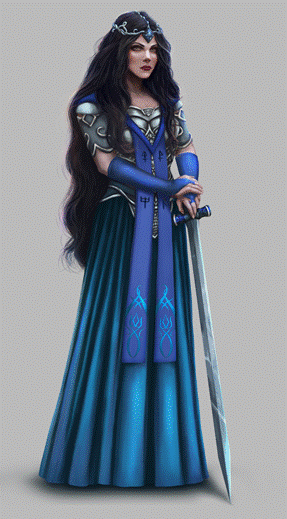
The En'miri are tall and fair-skinned
humans, who tend towards an athletic body structure. Most of them have dark
hair, and their eyes are blue, grey or green. They favor refined, elegant
clothing with subdued and non-flashy hues, sometimes adorned with delicate
embellishments that signify status or achievements. Their attire often displays subtle hues
matching the celestial reflection which the person or his lineage are, or
were once associated with associated: blue, red, grey or gold.
The En'miri originate from the Central Melestran Plateau. Around 600 years ago, following the
overthrow of the reign of the evil deity of pleasure, they conquered most of
the continent of Melestra, and established a vast matriarchal and strict
caste-based empire. The En'mirian empire was ruled by the 'Four Celestial
Reflections', mighty priestesses who were believed to be the 'reflections' of
divine gem-like entities from another, higher dimension. After centuries of victories, the empire
was hollowed out by corruption from within, sparking a great rebellion. Few
years later, the "Great Shattering" brought the empire down. The
Imperial Capital Selentir, the surrounding region and many other provinces
throughout the Empire were either destroyed or cut-off from the rest of the
world. The Celestial Reflections also disappeared, possibly perished, and
most of their priestesses lost their powers. Many of them died in agony, or
worse, succumbed to a strange disease, which slowly mutated them into
grotesque, deformed beings, a cruel mockery of their former powers. The En'miri of Kiern Vale are mostly
remnants of the provincial imperial nobility, or the descendants of various
scholars, senior artisans or officers in the legions or the imperial guards
that were stationed and lived in the Vale before the Great Shattering. Most
of the remaining En'miri still cling to the memory of their once great
matriarchal culture and traditions, including their devotion the celestial
En'mayri, though very few priestesses survived to guide them nowadays. Still torn between the supporters of
the Empire and the Grey Rose rebels, the surviving En'miri struggle to
survive and preserve the remnants of their once great civilization. But as
the years pass, more threats lurk and spread from all directions: from twisted
monsters and other lethal offsprings of the Great Shattering, to rival races
and cultures, who still remember (and not fondly) the iron fist of the empire
and are wary of seeing the En'miri recover to threaten them again. En'mirian Culture The En'mirian culture is primarily
urban and strictly aristocratic in its ideals, urging the individual to rise
himself above earthly and lowly passions, and gain both honor and elevation
of the spirit by serving the greater good of one's dynasty and empire. The
imperial aristocracy was primarily composed of "female dynasties" –
noble houses ruled by a powerful lady (often but not always a priestess) who
need not marry – an institution which was considered a demeaning custom
reserved for lesser noble houses ("male dynasties" who were titled
as such regardless of whether their ruling lord was male of a female). The En'mirian culture greatly valued
the practice of fine arts and crafting, especially the refining and crafting
of jewelry and magical gems. Military service and the chivalric orders were
also greatly respected. On the other hand, trade and especially agriculture
were regarded as inferior. The lowest of all occupations was mining, which
was typically reserved for slaves. Slavery is the ultimate punishment
inflicted on the unworthy, a deeply ingrained feature of the En'mirian
culture since times of old. Though the religion of the celestial En'mayri and
therefore the Imperial law strictly prohibited the kidnapping and trade of
slaves, considering it a depraved practice of the evil deity of pleasure,
slavery never completely disappeared, though most slaves in the imperial era
were either convicted criminals or war prisoners of all races and their lowly
status was not supposed to be hereditary. In the century that preceded the Grey
Rose rebellion, with the decline of the Empire and its priesthood, slavey
made a dark comeback. Thousands on thousands of slaves were 'employed' in
extremely harsh condition on the jungle province of Darnathon, and one of the
declared goals of the Grey Rose rebellion was the utter abolishment of
slavery in the empire – a major cause of attraction for many escaped slaves
from various lands and races into the ranks of the rebels. With the collapse of the Empire, the
mines and other economic activities dependent on large scale slavery have
collapsed as well, as has the coercive power to keep thousands of people in
bondage. Those who most profited from this vile institution, the Yellow
Priestesses and the orders of the south-see slavers, were gone, leaving few
proponents of the institution, even amongst loyalists seeking the restoration
of the empire. Thus in most remaining civilized regions of the former empire,
including the Kiern Vale, slavery has practically disappeared, though not
always officially. Relations with other Races Many of the En'miri do tend, to some
extent or another, to disdain other races, especially the human of the
Far'lil race. En'miri tend to view themselves as a superior culture, while
other civilizations and especially religions, are often seen as savage heathens
in need of discipline, sometimes by sword and fire. Accordingly, religious
tolerance in the En'mirian empire was very limited. Particularly reviled was
the patriarchal religion of the Far'lil, against which the Empire waged a
long and merciless war. The Gurg were overlooked by the En'miri
(and not only by them) as little more than vermin, scorned, but mostly
permitted to live their lives without interference. Ogres were considered
brutal barbarians and a constant threat to the empire, though some of their
achievements, especially in the field of magic, were acknowledged. The Ralg'kril race, living far under
their mountains on the western edge of the known world, were viewed as
sinister, near mythical beings. Influenced by the Mistweavers, the En'mirian
viewed the Ralg'kril as threatening, half-demonic beings. That said, most
En'miri were far less passionate about this matter then the Mistweavers. In
the rare occasions that Ralg'kril mercenaries or craftsmen offered their
service to the empire, they were accepted with tolerance and even respect,
though oftentimes mixed with suspicion and fear. Language The En'mirian Language is called
En'mirin, and serves as both the written and spoken language
("common") of Kiern Vale and many other lands that were once part
of the empire. It has three dialects: High En'mirin, Common En'mirin and low
En'mirin (also called "Gutter En'mirin" or "Gutmirin")
which is mainly used by slaves, criminals and beggars. En'mirian Names En'mirian names are closely related to colors,
primarily those which represent the En'mayri and the four Celestial
Reflections. Most names – mainly in higher dialects - include a high
apostrophe ('), which separates the first syllable from the rest of the name,
emphasizing the end of the first syllable and creating a slight pause before
the pronunciation of the rest of the name. The number of syllables in a given
name (1-3) indicates the birth status of the individual: most names of common
people' include two syllables, with the first one often connected to a
certain color. Names of nobles, priestesses and other high-status individuals
include three syllables. Names of slaves and those of very low status consist
of a single syllable. Common name prefixes
Common name suffixes
Common Example of middle- and higher-class names
Names of low status individuals and
slaves People of low status are considered without
affiliation to the En'mayri or the Celestial Reflections. The typically
receive names with a single syllable, used for both males and females, and
will never start with "A", "E", "R",
"T" or "D". For example: Brin, Blen, Kurn, Nag, Girn, Gar, Pert, Purg. En'mirian Family names Classic family names tend to have two or three
syllables, often incorporating a prefix of suffix related to a color which
belongs to one of the En'mayri: Special Prefixes for Noble lineage
names The names of En'mirian noble lineages always begin
with a distinct prefix to indicate their status. The most common noble
prefixes in Kiern Vale and adjacent regions are "Kor" (as in
"Kor Om'thel" or "Kor Avaril")
and Var or Varn. The prefix "A" (as in A Rel'arn
or A Tir'menel) suggest a priestly lineage
ancestry. The prefixes "En", "Sil" and "Siln" (like in: Sil Dar'mirn
or En Mir'kril) is rare, and hints a very high
origin (at least in ancient times), often from the imperial capital Selentir
or its surroundings. |
Back to the index of the
English version | Back to the index of the
Kiern Vale guide
Created and edited by Gideon Orbach (2017) ©
All rights reserved. Commercial use and/or any profit-making purpose is
strictly prohibited without explicit permission from the creator, in writing
and in advance. Noncommercial/personal use with no profit aim is allowed (and
even recommended!)