
Kiern Vale Handbook
Chapter 1: Introduction and History
of Melestra
Prologue | The History of Melestra
|Kiern Vale and its
surroundings |Timeline
|
The History of Melestra The Overthrow of the Reign of the Dark God of
Pleasure Over six centuries ago, a fading confederacy of now
forgotten city states was
ripped apart by a war between rival temples and priesthoods.
Only a few scholars yet remember the names of the contending priesthoods and
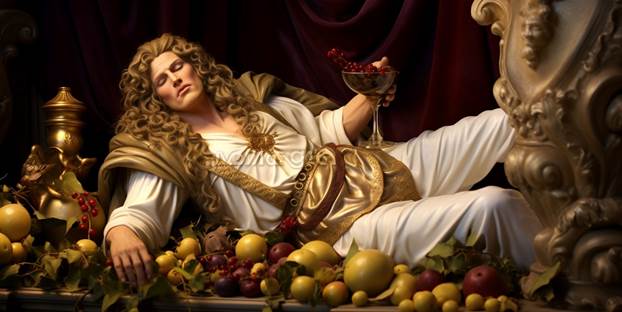
their respective deities. Seizing this opportunity, Babus, the God of
Pleasure, manifested into the world. Assuming a beautiful and powerful form,
he settled in the heart of the great city of Selentir. With
the aid of vacuous, yet devoted followers, who were promised boundless
wealth, endless pleasures and eternal youth, Babus degraded Selentir, then
many other regions around it, into a flesh-pit of indulgence, endless
debauchery and perversion. Many of the deity’s devoted willingly sacrificed
their souls, turning into beautiful “pleasure husks” who fueled the power of
Babus even further.
Following
several failed attempts to overthrow the evil deity and his horde of hedonistic
devotees, a group of young priestesses performed a powerful ritual that
opened a portal to another dimension. There, they bound themselves to the
power of the En’mayri –powerful sentient
gemstone-like entities, each of them possessing immense magical powers. The
rebellious priestesses assaulted Babus and his devotees at the heart of their
power, the “Temple of Seventy Pleasures” where Babus's
earthy manifestation reveled in its twisted delights with his pleasure husks.
There, they tore open a rift to the En'mayri
dimension, and in the terrible battle that ensued, not only the temple and
his surroundings, but many parts of the great city were destroyed; thousands
perished. When
the dust cleared from the ruins, Babus was gone, its manifestation
incinerated to ashes. The spirit of the evil deity fled back to the void from
whence it came. The four surviving priestesses took control over Selentir’s remains, pledging to restore the city with the
help of the mighty celestial gemstones, and elevate it to heights never
before imagined. The En’mirian Empire Thus
rose Kor’enmora, the En’mirian
Empire The imperial era was considered by many to be a golden age of wonder,
whereas others decried it as an age of dark tyranny, in which the En'mirian priestesshood bound
the world merciless chains embedded with magical gemstones. At
the pinnacle of the empire were the radiant priestesses of the celestial
gemstones, led by the council of the four “reflections” – the four
priestesses who survived the battle with Babus. According
to the tenets of the En’mirian belief, these four heroines were
no longer mortal priestesses, but manifestations of the En’mayri
themselves. Over time, each of the four reflections was attributed different
roles or qualities, linked to her celestial gem (or perhaps, to her own
personality). Der’theria:
The Golden Reflection. Revered as mistress of war, punishment and vengeance
against the creatures of darkness and the enemies of the empire. Teal’arniss: The Blue Reflection. Revered as lady of honor,
transcendence and chivalry, also associated with honorable sorrows and
similar virtues. On’meara:
The Grey Reflection. Revered as all-seeing mistress of wisdom and scholars,
the lady of both true sight and illusions. Ryl’klaria:
The Red Reflection. Revered as mistress of perfection, beauty, artisans and
art. The
debauchery and chaos of Babus's reign were replaced
by a religiously mandated regime espousing order and discipline: A society
where every Individual – from the priestesses at the top, through the noble
houses, the knights, the guilds of artisans, to the commoners at the bottom –
knew their place. From this stern order rose the En’mirian
Legions, led by gemstone-bearing priestesses and aided by mounted knights and
magic users. One by one, Melestra’s nations and
tribes were conquered and reorganized into imperial provinces: some swore
allegiance and willingly kneeled before the radiant council, while others
fell in blood and fire. No
one could stand against the radiant priestesses: not
the defiant herders of the northern steppes, with their shrines and their
wild deities of hooves and horns; Not the proud Mistweavers of the Western
Continent of Narlirdrea, who believed that their
race was chosen by the queen of light; Not even the ancient Ogres with their
hordes of bloodthirsty warriors, their gigantic walls
and towers of stone, and their mighty wizards who possessed magical stones,
as ancient as Melestra itself. For
over five centuries, the radiant council ruled without hindrance, turning
Selentir into the “The glowing jewel of the world”. Imperial loyalists claim
that it was a golden era. Beauty and order reigned supreme, trade flourished,
and the temples and mansions were full with magnificent art and writings of
wisdom. Others claim that the “radiant liberators” quickly turned into
oppressors, and though their strict regime was vastly different from the
bloody rampage of Babus and his soulless devotees, in practice it was not
much better: especially in the provinces far from the imperial core, and for
those – humans or demi humans – that were not part of the En’mirian
– the founding race of the Empire. Last
but not least: there were also whispers that the connection to the celestial
dimension of the En’mayri claimed a toll on the
reflections, a toll the four reflections – who lingered for hundreds of years
as if they were immune to age -had good reason to conceal from the masses. It
is said that the empire gradually sank into cruelty, corruption and
deterioration. It remains uncertain whether the illness came from evil
spirits that began to influence the radiant council, (particularly, as many
claimed, the Golden Reflection), or it was due to corrupt governors and
wicked merchants operating behind the back of the priesthood – some of them
whom never forgot Babus (as imperial loyalists claim today). The
strict caste system, and especially its meticulous supervision over
everything related to the extraction and crafting of precious stones,
tightened its grip as the holy powers of many of the priestesses waned. With
it faded their ability to evoke the powers of the magical gems that were the
centerpiece of the jewelry which signified their status. The
slave trade that flourished under the reign of Babus, though it was strictly
prohibited by En’mirian law, was never entirely
eradicated. As moral turpitude overtook the empire during its final century,
it crept back. According to some accounts, in the gem mines owned by the
council, thousands upon thousands of miserable souls were ‘employed’ under
horrendous conditions: convicted criminals, defeated rebels, and sometimes
even personal rivals of powerful priestesses or dynasties, convicted on false
charges. The
greatest and worst of these mines sprawled deep into the humid and sweltering
jungles of the Darnathon province in the south, a
place whose mere name was sufficient to chill even the most hardened hearts.
This region had become the “private playground” of the priesthood serving the
Golden Reflection and their allies. Rebellion of the Gray Rose About
65 years ago, the hammer fell: a failed war waged by the empire and its mistweavers vassals against a demonic race in the
north-western edge of the world, and several local rebellions that were not
entirely vanquished by the fatigued forces of the empire. Those struggles,
added by internal conflicts within the radiant council and between the
supporters of each reflection, pushed the empire to the brink of collapse. Subsequently,
various rebel groups united under the charismatic leader Min’loril,
also known as the “Grey Rose”. Min’loril claimed
that the council had betrayed and corrupted the empire, and that the
connection between the four reflections and the celestial En’mayri
had long faded. The Grey Rose followers asserted that Min’loril
herself was the new and true reflection of the celestial grey En’mirel. Under
the Command of the Grey Rose, diverse groups gathered: from several
disgruntled yet experienced En’mirian legion
officers, who vowed not to lay down their weapons until the council bowed
before their leader, and the Empire underwent significant reforms, to masses
of escaped slaves, fascinated by Grey Rose’s intention to end or at least
significantly curtail slavery, and to dismantle the notorious slavers orders. The
radiant council responded fiercely. It is reported that prior to the outbreak
of open war, at least one of the four reflections was willing to negotiate
some of the demands of the Grey Rose. However, the public declaration that
the Grey Rose herself was a new celestial reflection was considered by the
council as an unforgivable heresy a deadly challenge to the legitimacy of the
imperial order which had to be crushed.
The
council, led the Golden Reflection (whose personal loath for Grey Rose
preceded the rebellion by many years), mobilized its loyal legions, swore to
crush the rebels and shatter Grey Rose herself to tiny shards while she is
still alive, and to cast her tormented soul into the endless abyss of the
realm of shadow. In practice, the empire’s attempts to suppress the rebellion
were, at least initially, hesitant and sluggish – as the various underlings
of the council mistrusted each other much more then they loathed the rebels.
In the meantime, Grey Rose gained significant strength as she broke another
taboo and formed an alliance with the leader of a major slave rebellion – a
charismatic leader of the Far’lil humans, who had
openly expressed his disgust for the empire and its matriarchal regime,
calling his followers to return to the ancient and nearly forgotten
patriarchal nature religion of their ancestors. The
war between the radiant council and the Grey Rose rebels was long and brutal,
experiencing twists and turns, with neither side achieving absolute victory.
Cities and regions changed hands, and both sides accused each other of
barbarism and horrific deeds. Grey
Rose launched a military campaign to conquer the vast peninsula of Tilmarn in the western empire. Initially successful, her
advance was halted in the great battle of Lin Morlith,
where frost knights loyal to the Blue Reflection repelled the rebels from
advancing into the great Karansil mountains. Perhaps
due to anger over this failure, or due to other, more personal reasons, Grey
Rose made a strategic gamble: her main army combined forces with the former Far’lil slaves who sought to free their enslaved
brethren, and was redirected into the plague ridden and perilous jungles of Darnathon in the south. There, sprawled the great
gemstone mines, overseen by the strongholds of three senior matrons favored
by the Golden Reflection. Sensing
an opportunity, the council sent forth Golden Reflection herself into battle,
leading a vast army. The Golden Reflection vowed to personally ensure the
destruction of Grey Rose and “The entire filthy swarms of traitors and
slaves” which followed her. The Great Shattering There
are many conflicting versions of what happened afterward: which side the
battle favored, and what army, if any, was the one who had concealed a
horrifying weapon, a force not of this world, deep beneath the jungles and
swamps of Darnathon. Whatever the truth behind the
rumors, some eldritch power was unleashed in the battle, resulting in an
explosion making the destruction of Selentir in the battle against the Deity
of Pleasure seem like mere child’s play. Supporters
of the Grey Rose claim that it was a final act of spite by the radiant
council, especially the Golden Reflection, realizing that were about to lose
the final battle. Imperial loyalists, in contrast, believe that it was the
Grey Rose who sought to use an ancient and forbidden artifact, which slipped
out of control and caused the horrifying disaster. Either
way, the terrible explosion that struck Melestra, referred by all as “The
Great Shattering”, shook the foundations of the world, leavinga
terrible aftermath in its wake. Mountains
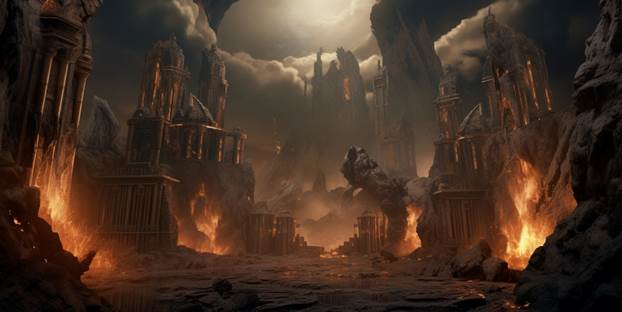
crumbled; cities shattered like eggs on a rock, or slid into the boiling
waters of the sea; plains were split by chasms whose depths extended for many
miles. Ancient forces, carriers of disease and wild magic from forgotten
times, awoke and rampaged without restraint. It
is said that the imperial capital Selentir itself crumbled, and the three
reflections that resided in it vanished without a trace. Nearly half of Melestra’s inhabitants disappeared or perished within a
few weeks. Others died later of hunger, diseases and wars that erupted in the
bitter years that followed. In
the southern Province of Darnathon, where the Great
Shattering began, both the Grey Rose and her hated rival the Golden
Reflection perished, along with the majority of both armies. The province
itself turned into an inferno of boiling soil and toxic fumes, with the flora
itself twisting into poisonous, predatory nightmare.
The
horror did not end there. A strange effect accompanied the great disaster,
poisoning many spell casters and priestesses, especially those who followed
the Golden Reflection. For some, death was instant, for others - a slow and
painful process over the next months or years. Those victims lost their
sanity, and often mutated into grotesque, deformed monsters, a cruel mockery
of their former powers. The
mighty En’mirian empire, which dominated the known
world for over five centuries, was torn asunder, leaving only remnants
behind. These remnants were forced to fight for their mere existence in a
world that had changed entirely. Many formerly subjugated rivals stirred in
the aftermath of the shattering, seekingto “settle
the score” with the sorry remnants of the once great En’mirian
civilization. Melestra after the Great Shattering Five
decades have passed since the shattering. Many parts of the world remain a
chaos of sunken or half buried ruins, crawling with deformed monsters.
Surviving cities and villages are fighting each other for what little scraps
of wealth and land remain, while barely fending off hunger, plagues and
monsters. While
some remnants of the empire still try to hold their ground and rebuild parts of
their fallen civilization, shadows lurk in the darkness, and the drums of war
echo once again across Melestra. The
Ogres once again muster their strength, rebuilding their ancient temples of
stone, training new war mages and sending forth hosts of raiders mounted on
massive carnivorous reptiles. Across the western see, in the continent of Narlirdrea, the ancient kingdom of the Mistweavers was
sacked by an alliance of human tribes that the Mistweavers overlooked for
many generations as their inferiors. Many of the once proud Mistweavers were
slaughtered or taken into slavery, while others scattered, becoming desperate
refugees. In the misty hills of the north, Garlard Frun, a former ally of the Grey Rose who survived the
battle of Darnathon, has declared himself a great
prophet of Par Egul, the ancient god of the Far’lil race. It is said that Prophet Frun
is gathering a zealous army for a new war, intended to burn away the very
memory of the En’mirian civilization. The prophet
claims that even his former En’mirian allies, the
Grey Rose and her officers, not only ignored his advice, but also planned to
betray him and the other Far’lil after the war –
thus proving that everything stemming from the empire and its religion must
be uprooted with blood and fire. The regent A-Rylarion and
the disputed peace agreement In
the western edge of the vast peninsula of Tilmarn,
which witnessed some of the most brutal battles between the Grey Rose rebels
and the forces of the empire, half of the once magnificent harbor city of Til’mirlen sank into the sea. Its remnants had become no
more than a mediocre fishing town, stricken with poverty and internal
struggles. However,
two decades ago, a small army anchored there, led the lady Los’erlin A-Rylarion, one of
the closest officers and advisors of the Grey Rose, whose forces somehow
survived the Shattering. According to the tales, Grey Rose ordered the forces
of A-Rylarion to sail back from the south to Tilmarn peninsula, few weeks prior to the last battle, to
carry out a secret and crucial mission. When the disaster occurred, A-Rylarion’s forces were in the heart of the ocean, and was
about to be torn apart and sink into the depths. However, the great wizard
who accompanied Los’erlin and her troops saw the
approaching doom, and saved the fleet using a powerful time-stopping spell,
at the cost of his own life. The spell did indeed shield A-Rylarion’s forces and froze them within a statis field
for three decades. After
anchoring in Til’mirlen, the army of A-Rylarion faced only a local militia, and easily seized
the harbor town. There, lady Los’erlin established
her rule, crowning herself as “Regent of the Grey Rose”, and claiming that
her lady brought a young male heir into the world, and transferred her powers
to him. Allegedly, the mysterious child, son and heir of the Grey Rose, was
entrusted to her protection until reaching maturity. However, imperial
loyalists ridiculed this claim as arrogant heresy, additional evidence that
the Grey Rose herself was nothing but an imposter: according to En’mirian religion, the powers of a priestess of the
celestial gemstones can never manifest in a male heir. Rather,
the imperial loyalists suggested an “alternative interpretation”: that the
leader of the accursed rebels had “amused herself” with some of the escaped
slaves in her camp, leading to a single, pathetic result. Moreover, rumors
over the years suggested that the young heir was nothing than a plump,
simple-looking adolescent, devoid of any real power. However,
much to the disappointment of many on both sides, the renewed war did not
break out yet. The rebel remnants and the various imperial loyalists were
both too occupied, beset by enemies and dangers from all sides, and suffering
from a shortage of people and resources to fight “a proper war”. A few years
later, shocking news spread through the entire peninsula: a secret
negotiation yielded a peace agreement between the Grey Rose regent and Grand
master Lin’ros Kor-Tilgalar,
in the name of the Frost knights and priestesses loyal to the Blue
Reflection, dwelling over Karansil Ridge. In the
agreement, both sides acknowledge being successor to the En’mirian
civilization, whose remnants are under threat from all directions. Thus, both
sides set aside their differences to protect what was left from Kor’enmora from the looming and intensifying threats. Alongside
many supporters of the agreement, particularly those who sought to avoid a
war that would jeopardize everything left after the Great Shattering (And
unintentionally aid the Ogres and especially Far’lil
zealots, minions of prophet Frun, who already began
mustering great forces in the eastern part of Tilmarn)
many others rose against the disputed treaty, and deemed it an outright
betrayal. The
largest surviving Kingdom on the peninsula – Orm’theril
– declared itself vehemently opposed to the peace agreement. This kingdom was
traditionally loyal to the Grey Reflection, though according to growing
rumors, its young and stubborn high prince is greatly influenced by a strange
scholar, espousing theories about an ancient race of Ape-men whose blood
pollutes the entire race of men. Even Los’erlin’s
own forces were polarized by the peace treaty. The situation almost escalated
into a sword fight within the regent’s new founded palace: one of Grey Rose's
surviving veteran officers, a close friend turned rival to the regent
herself, named En’liris Korvarion,
led a furious group of warriors who stormed the palace, Bloodshed was avoided
only due to the intervention of the young heir himself. Following harsh words
between the regent and her past friend captain Korvarion,
the later – with nearly one third of Los’erlin’s
forces, left the harbor city and the service of the regent, and relocated to
the far south of the peninsula, in the troubled marshlands of Nol-Darath.
There, they proceeded to periodically clash with remnants of one of the
loyalist Golden Reflection legions. At
the meantime, as the newborn peace is on the verge of faltering, the nights
darken, and the shadows grow longer. Both ogres and the zealous followers of
the Prophet Frun are preparing for war; evil
spirits creep in the southern forests, where poisonous spores are expanding,
possible carried by roaming deformed monsters – some of them already seen
within the borders of the Tilmarn Peninsula. |
Back to the index of the
English version | Back to the index of the
Kiern Vale guide
Created and edited by Gideon Orbach (2017) © All rights
reserved. Commercial use and/or any profit-making purpose is strictly
prohibited without explicit permission from the creator, in writing and in
advance. Noncommercial/personal use with no profit aim is allowed (and even
recommended!)